Kalinia
The Ballad of the Last DragonKalinia is a busy town whose open market, crowded square, and magistrate’s office bring together the novel’s central tensions: movement and belonging, performance and authority, and private survival under discriminatory social laws. The expedition reaches it after the assault on Sylvaine Abelan and the execution of the men responsible, so arrival in Kalinia marks not a simple return to ordinary life but the beginning of a new struggle over home, inheritance, and justice.
Setting and Arrival
Kalinia is reached when the sun is high, after the travelers have spent a night on the road and Sylvaine Abelan has withdrawn from the others in exhaustion. The journey is still physically immediate: her clothing is hot against her skin beneath the midday light, while a breeze cools her arms when she pushes up her sleeves. She repeatedly expects to pull those sleeves down again, indicating how exposed and vulnerable she feels even while entering a public place.
The town itself is presented as active and commercially open rather than remote or deserted. Shops are open, people move through the streets, and the market is crowded with vendors and fruit stands. A bard performs in the square, wearing an oversized black muffin cap and playing a lute while singing about lost love. Sylvaine, normally the performer, pauses to watch him as an audience member; his wink draws laughter from her. That brief reversal gives Kalinia an unusual emotional texture: it offers a public world in which she can momentarily observe rather than defend, and in which artistic exchange can still produce pleasure after the preceding violence.
Home, Inheritance, and Domestic Stakes
Kalinia is also the place where the question of ownership becomes intimate. Rhosyn explains that she has no interest in marrying Jaromir, yet fears that her daughters will lose their home. The house was built by Damir, and its ordinary physical details preserve him: a creaking floorboard and a nail on the third step that he never fully hammered down. The property therefore represents more than land or legal entitlement. It is the material continuation of Damir’s presence and the site where Rhosyn and her family imagined their future.
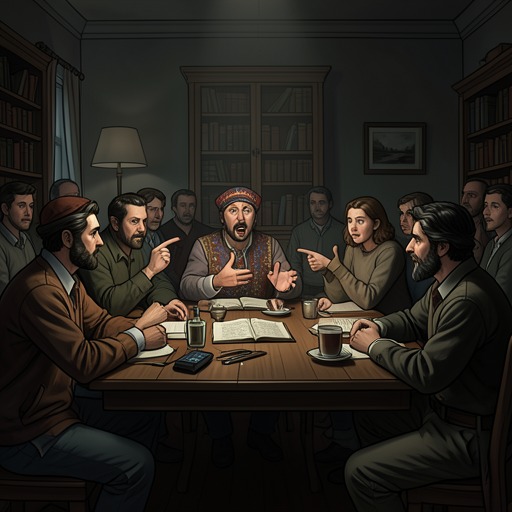
Rhosyn’s position is complicated by the planned winter union with Jaromir. Their arrangement permits both of them to live as unattached before the marriage, but the marriage itself is expected to be taken seriously. Rhosyn has known Jaromir all her life and regards him as Damir’s brother and her friend, not as a beloved partner. She once hoped that affection might grow from friendship and respect, but her immediate concern is preserving the home for her daughters. Kalinia thus concentrates the conflict between an imposed marital solution and a woman’s attachment to the property, memory, and family life she already possesses.
Public Authority and Sylvaine’s Defiance
The town’s institutional power is represented by Magistrate William M. Ridion, whose office is marked by visible wealth and cultivated taste. Sylvaine Abelan notices the magistrate’s ebony desk, carved with intricate shapes and filigrees, while sitting in its cushioned chair with her feet resting on its surface. Her deliberately insolent posture turns the office into a contest over who is entitled to comfort, refinement, and authority.
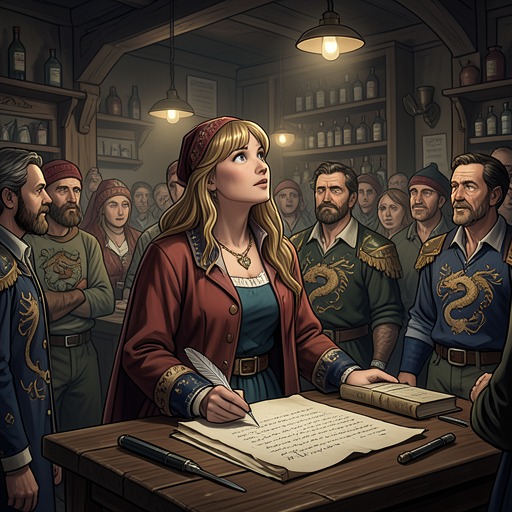
Sylvaine has not come to the magistrate through a delicate petition. After verifying her suspicions with Rhosyn, she chooses coercion and theatrical confrontation. She introduces herself as a bard, defender of written and spoken words, acting notary, formidable slinger of stones, and guide for a better tomorrow. The performance is not empty ornament: her artistic identity, legal usefulness, and practical skill are presented as a single source of power, allowing her to challenge an official on his own ground while refusing the social role assigned to an elf woman.
Ridion responds by calling her an elf who believes herself superior to gutter refuse. His insult makes explicit the anti-elf prejudice that has already shaped Sylvaine’s life and helps explain why a public office in Kalinia is not a neutral space for her. Jaromir answers the insult physically, clamping a hand around the magistrate’s throat and warning him to watch his tongue. Sylvaine’s defiance and Jaromir’s intervention operate together: her speech exposes the structure of contempt, while his threat prevents the official from treating that contempt as consequence-free.
The Town as a Place of Threat and Recovery
Kalinia’s public sociability exists beside serious danger. Before reaching the town, Sylvaine has already learned to treat groups of loud men as a potential threat. When she overhears three men approaching while she is alone in a field, she hides in a tree with her lute on her back and keeps one hand near the short sword Neith insisted she carry, as well as the shepherd’s sling in her pocket. The men resemble rowdy tavern patrons, and her caution reflects a reality she bitterly accepts: she normally avoids being alone and far from witnesses.
The later assault makes the danger concrete. The attackers restrain her wrists and feet, force her legs apart, stuff her crumpled cap into her mouth, and loom over her while she screams, bites, claws, kicks, and tries to use her body to throw them off. Her broken lute presses sharp edges into her back, transforming the emblem of her profession into an instrument of pain. Kalinia is therefore approached through the aftermath of an attack in which gendered violence, anti-elf vulnerability, and the precarious safety of a traveling performer overlap.
Even after the attackers are killed, Sylvaine refuses to turn the act into a heroic legend. She acknowledges that the men were executed and that she did not oppose their deaths, but rejects the language of heroism. That moral clarity follows the travelers into Kalinia: the town is not a clean restoration of order, but a place where survivors must continue acting amid guilt, anger, and unfinished social injustice.
Political Consequences and Belonging
The most decisive change associated with Kalinia is Rhosyn’s successful recovery of proof of ownership. After leaving Ridion’s office at dusk, Sylvaine carries the documents while Rhosyn and Jaromir follow. Outside, beneath the first stars, Sylvaine retrieves the coin purse she stole from the magistrate’s desk and plans to give the money to the mothers of his forgotten children, recasting theft as a form of civic upkeep. Rhosyn, staring at proof that the home is hers, first expresses disbelief and then embraces Sylvaine and spins her around in gratitude.
This outcome changes the meaning of Kalinia’s institutions. The magistrate’s office begins as a site where class privilege and anti-elf contempt are displayed through furniture, insult, and official power. It ends as the place from which Rhosyn emerges with material security, while the magistrate loses money and is forced to tolerate Sylvaine’s continued public presence. Sylvaine even invites him to attend her performance the following evening, extending her challenge from the office into the town’s cultural life.
Kalinia consequently functions as more than a stop on the expedition’s route. It is a threshold between flight and settlement, between private grief and collective action. Its market offers the fleeting pleasure of being an audience member; its domestic spaces preserve a dead man’s touch; its offices enforce exclusion; and its streets become the setting for an improvised victory. Through Rhosyn’s home and Sylvaine Abelan’s intervention, Kalinia shows belonging not as a privilege granted by authority but as something defended through memory, solidarity, performance, and determined resistance.